
Mastering the Clean Fuel Regulations: In-Depth Lessons from the 2022 Verification Review
ECCC's 2022 CFR verification review uncovered critical gaps and best practices across 55 credit-creation reports. Here's what verifiers and compliance officers need to know to strengthen future reporting.

KeeWee -
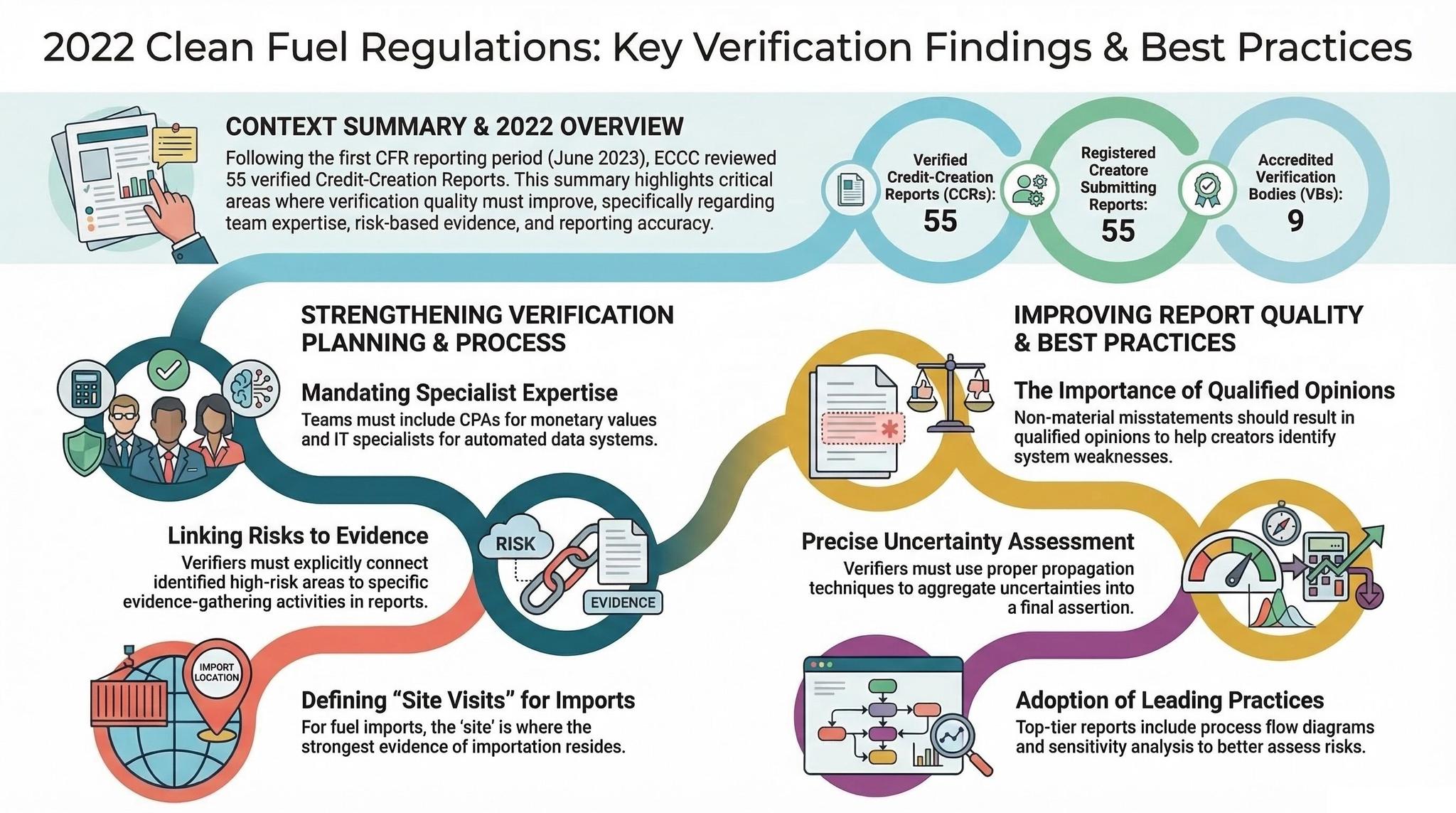
In February 2024, Environment and Climate Change Canada (ECCC) released a comprehensive review of the first reporting period for the Clean Fuel Regulations (CFR). This review covered fifty-five verified credit-creation reports (CCRs) submitted for the 2022 compliance year, involving nine accredited verification bodies (VBs). The goal was not just oversight, but compliance promotion: helping registered creators and verifiers understand their obligations and improve the quality of future reporting.
For those navigating this complex regulatory landscape, the ECCC's findings provide a detailed blueprint for success. Here is an in-depth look at the critical areas identified for improvement.
1. The Critical Role of Technical Specialists
The review emphasized that verification is no longer a generalist's task. Depending on the report type, specific expertise is mandatory or highly recommended:
-
Financial Accounting Specialists (CPAs): When a report involves compliance-credit revenue or contributions to emission-reduction programs, a CPA (or equivalent) must be on the team. They focus on verifying monetary values, ensuring that accounting controls for revenue are adequate, and identifying any discrepancies between a company's financial records and what was submitted to the Minister.
-
CAATTs (IT) Specialists: While not strictly mandatory, ECCC strongly encourages using specialists in Computer Assisted Audit Tools and Techniques (CAATTs) when a creator uses an automated Data Management System (DMS). These specialists evaluate the "man-machine interface," data integrity controls, and security protocols like firewalls and intrusion detection.
-
Geological Carbon Storage Specialists: For carbon capture projects, these experts must establish the suitability of geological formations and evaluate monitoring plans for potential seepage or physical leakage.
2. Advanced Risk Analysis and "The Linkage"
One of the most common shortcomings in the 2022 reports was a lack of clear linkage between identified risks and the activities used to find evidence. ECCC provided clear definitions to help verifiers:
-
Inherent Risk: The "natural" level of risk in a process before any controls are applied—essentially, the risk of an error occurring due to the nature of the activity itself.
-
Control Risk: The risk that a misstatement will occur because a company's internal preventive checks failed.
Verifiers must design activities that respond specifically to these risks. For instance, high measurement uncertainty (inherent risk) might be addressed by reviewing disclosure policies, while an inaccurate meter (control risk) requires checking calibration records. Furthermore, risk ranking must be specific to the report being verified, rather than applying a generic ranking across the entire CFR.
3. Defining the "Site" and "Point of Import"
A major point of clarification involved the definition of a "site" for fuel importers. Under the CFR, the "point of import" is considered the site for verification purposes. Crucially, this is not necessarily the physical border crossing or customs port. Instead, it is the location where the strongest evidence of the transaction exists—often a centralized office or data centre where records are managed.
If the data resides in a virtual computerized system, a site visit to where that system is housed is required. ECCC noted that while virtual site visits are possible, the reasoning for choosing a remote visit must be documented in the verification report.
4. The Importance of "Qualified Opinions"
In the world of auditing, a "qualified opinion" can seem like a failure, but ECCC views it as a vital improvement tool. A qualified opinion is issued when a report contains misstatements that are not material. These opinions allow verifiers to point out non-conformities—such as a monitoring plan that is missing specific required information—without rejecting the report entirely. This feedback helps registered creators fix their systems before small errors turn into material compliance issues in future years.
5. Technical Accuracy: Rounding and Uncertainty
The review found that many reports struggled with technical data standards:
-
ASTM E29-22: This is the required standard for all rounding in the CFR. ECCC noticed some reports used too many significant digits, which incorrectly implies a higher level of accuracy than actually exists.
-
Uncertainty Propagation: Verifiers must use proper methodologies to aggregate uncertainties across multiple data points. For example, in a network of 10 EV charging stations where each has a 1% error, the aggregated uncertainty for the total electricity dispensed actually drops to 0.3% when calculated correctly.
6. "Gold Standard" Best Practices
ECCC highlighted several voluntary practices that elevated the quality of verification reports:
-
Process Flow Diagrams: These provide essential context for the distribution of risk throughout a system.
-
Sensitivity Analysis: This helps verifiers understand "non-linear" systems—where a small change in one variable might have a disproportionately large impact on the final credit count.
-
Version Controls: High-quality reports included clear versioning, showing the progression from the initial draft to the final independent review.
By adopting these rigorous standards and leveraging the ECCC's feedback, registered creators and verifiers can ensure that Canada's transition to cleaner fuels is supported by data that is as reliable as it is impactful.