
Evolving Compliance: In-Depth Insights from the 2024 Clean Fuel Regulations Verification Review
A breakdown of ECCC’s 2024 review of Clean Fuel Regulations, highlighting key compliance insights, verification challenges, and recommended best practices.

KeeWee -
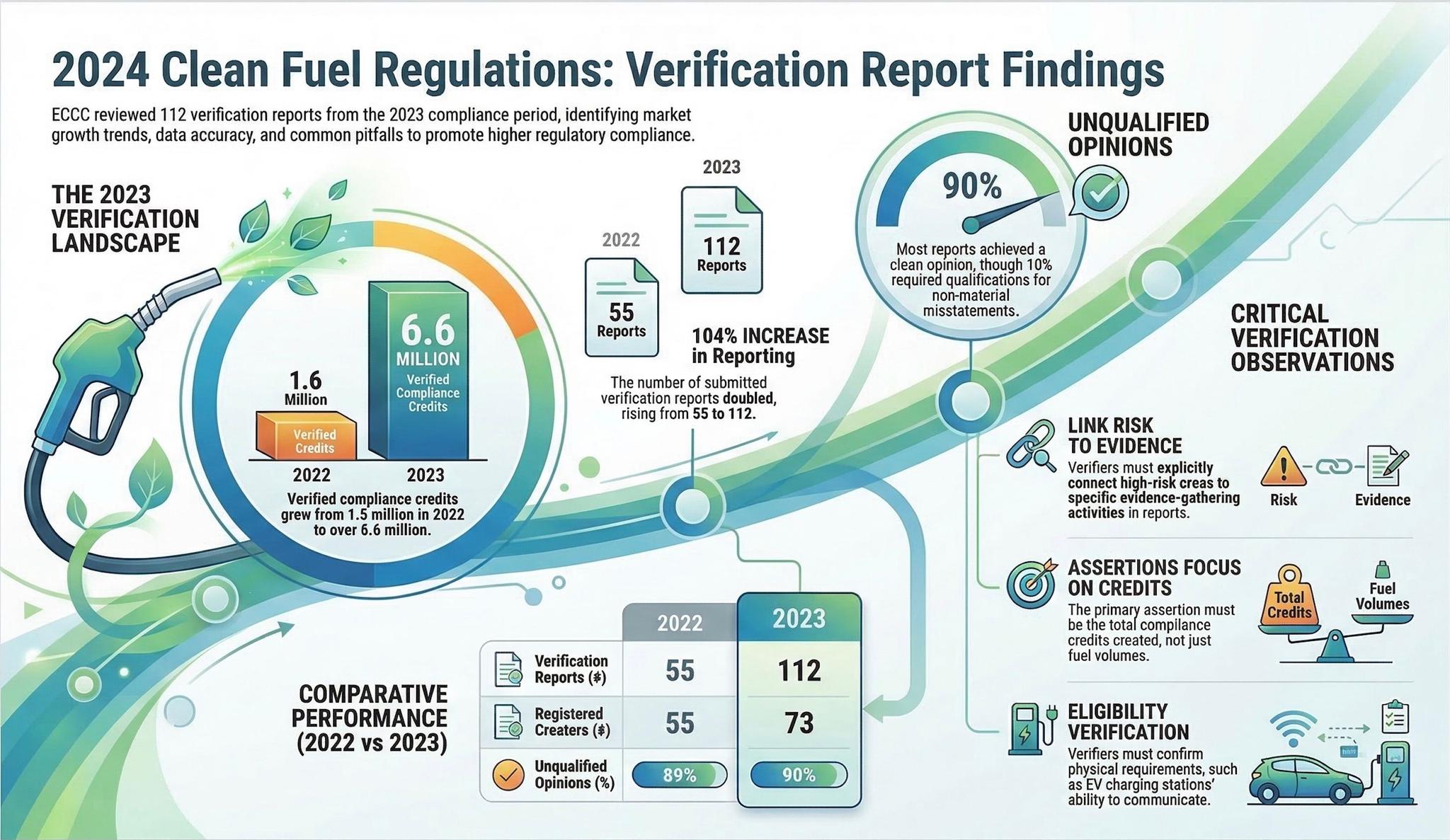
Following the release of the 2023 findings, Environment and Climate Change Canada (ECCC) has published a new review reflecting on the 2023 compliance year. This period marked a significant expansion of the program, with 112 verification reports submitted—more than double the previous year—covering over 6.6 million verified compliance credits.
The 2024 review highlights a maturing system, with 90% of reports receiving an unqualified opinion. However, ECCC has identified specific technical areas where verifiers and registered creators must sharpen their focus to ensure the long-term integrity of the Clean Fuel Regulations (CFR).
1. Defining the "Benchmarks": What Counts as Criteria?
A recurring point of clarification in the 2024 review is the definition of verification criteria. Criteria are the benchmarks against which regulatory reports are compared. ECCC emphasized that while the CFR and specific Quantification Methods (QMs) are primary criteria, certain documents are not considered criteria, including:
- The CATS User Guide
- The verification body’s internal manuals or policies
- Standard ISO accreditation documents (e.g., ISO 17011 or 17029)
Verifiers must ensure that the criteria used for the audit are clearly identified and consistently applied throughout the verification report.
2. The Main Assertion: It’s All About the Credits
ECCC noted that in many Credit-Creation Reports, there is confusion regarding the "assertion." While fuel volumes or energy dispensed underpin the data, the main assertion is the total number of compliance credits created.
All contribution, error, and uncertainty analyses must be performed on the credits themselves, not just the underlying activity level data. Furthermore, the assertion in the verification report must match the regulatory report exactly, including sub-components like liquid and gaseous-class credits.
3. Deep Dive: Electric Vehicle (CC3) Eligibility
As the electric vehicle (EV) sector grows, the 2024 review placed a heavy emphasis on the strict definitions of charging stations under Compliance Category 3. To be eligible for credit creation, a station must:
- Be located in Canada and charge a battery on board an EV
- Be capable of communicating with a server via the internet or cellular signal
- Report both the quantity of electricity and the time it was supplied
Crucially, ECCC clarified that indirect measurement techniques to determine electricity dispensed are not acceptable; the station itself must measure the supply. Additionally, credits can only be created starting the day after the creator’s registration is submitted.
4. Evidence Integrity: Attestations vs. Confirmations
The review raised concerns about the strength of evidence being used.
Attestations:
These are considered weak forms of evidence because they are essentially written forms of oral testimony. Relying solely on attestations is insufficient for a "reasonable level of assurance" and requires cross-checking with base records.
Confirmations:
A stronger approach involves obtaining evidence directly from a third party (the "confirming party"), such as electricity or natural gas invoices and cargo manifests.
5. Virtual vs. Remote: Navigating Site Visits
The 2024 findings provide a clear distinction for modern auditing environments:
- Virtual Site Visits: These occur in online environments with no physical location, such as data warehouses, cloud systems, or servers.
- Remote Site Visits: These occur when a site has a physical location, but the verifier conducts activities from a different location (e.g., via MS Teams).
An MS Teams meeting is considered a remote activity, not a virtual site visit. If a required physical site visit is replaced by a remote session, the verifier must explicitly disclose the reasoning and the associated detection risks in the report.
6. The “Gold Standard” for Future Compliance
To further enhance transparency, ECCC is encouraging “best practices” that go beyond the minimum requirements, including:
- High-level process flow diagrams to map out data movement
- Historical analysis comparing current data to previous years
- Cross-Regulation Comparisons: Verifiers are encouraged to compare fuel volumes reported under the CFR with data submitted under other federal regulations, such as the Sulphur in Gasoline or Benzene in Gasoline Regulations. Any material discrepancies between these reports should be investigated and justified.
By focusing on these detailed requirements, participants in the CFR can move beyond simple reporting toward a robust, data-driven compliance framework that withstands international scrutiny.