
CORSIA – Sustainable Aviation Fuel
Understand how SAF meets CORSIA requirements through lifecycle emissions calculations, ILUC determination, emission credits, and verified reporting frameworks.

Minxing Si -
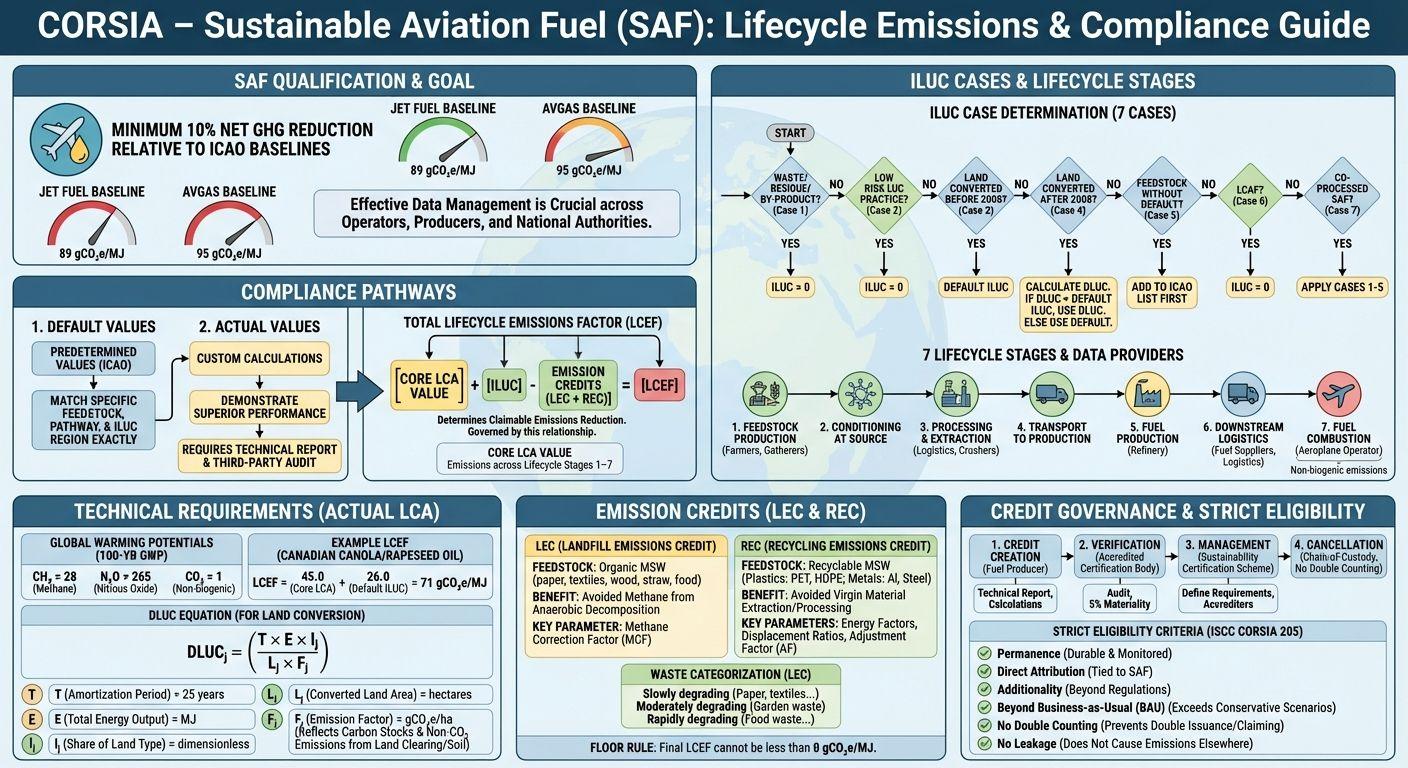
To qualify under CORSIA, a fuel must demonstrate a minimum 10% net greenhouse gas (GHG) reduction relative to ICAO’s life-cycle baselines of 89 gCO₂e/MJ for jet fuel and 95 gCO₂e/MJ for aviation gasoline (AvGas).
Meeting these requirements demands proper data management between operators, fuel producers, and national authorities. This guide provides a technical and strategic overview of how lifecycle emissions are calculated, documented, verified, and ultimately used for compliance.
Understanding Total Lifecycle Emissions Factor (𝐿𝐶𝐸𝐹)
The total lifecycle emissions factor (𝐿𝐶𝐸𝐹) determines how much emissions reduction an operator can legitimately claim.
ICAO provides two compliance pathways:
1. Default Values
Predetermined values published by ICAO for specific feedstock-pathway combinations. Operators must ensure the fuel exactly matches the feedstock type, conversion process, and Induced Land Use Change (ILUC) region listed in the ICAO Annex.
2. Actual Values
Custom calculations that allow fuel producers to demonstrate superior performance. This route requires a Technical Report and a comprehensive third-party audit of the entire supply chain.
The total lifecycle emissions value is governed by the following relationship:
Where:
- Core LCA Value represent emissions across each lifecycle stage 1 – 7
- Emission Credits
- LEC = Landfill Emissions Credit
- REC = Recycling Emissions Credit
seven specific cases that determine which ILUC value must be applied to the LCEF calculation:
- Case 1: Waste, Residue, and By-products: For feedstocks categorized as wastes, residues, or by-products (such as used cooking oil or tallow), the ILUC value is fixed at zero.
- Case 2: Low LUC Risk Practices: If the feedstock is produced using verified "low risk" land management practices (e.g., yield increase or unused land approaches), the ILUC value is zero.
- Case 3: Land Converted before 2008: If feedstocks were sourced from land converted before 1 January 2008, the operator must use the Default ILUC value provided by ICAO.
- Case 4: Land Converted after 2008: If feedstocks were sourced from land converted after 1 January 2008, the operator must calculate the Direct Land Use Change (DLUC) emissions. If the calculated DLUC is greater than the default ILUC, the DLUC value replaces the ILUC; otherwise, the default ILUC value is used.
- Case 5: Feedstocks without Default Values: If a feedstock does not yet have a default value, it must be added to the official ICAO document "CORSIA Default Life Cycle Emissions Values for CORSIA Eligible Fuels" before it can be used.
- Case 6: Lower Carbon Aviation Fuels (LCAF): For conventional petroleum fuels with reduced carbon intensity, the ILUC value is zero.
- Case 7: Co-processed SAF: For sustainable fuels produced alongside fossil fuels in a refinery, Cases 1 through 5 apply equally.
Supply Chain
| Supply Chain Element | LCA Stage(s) | Reporting Requirement | Primary Data Provider |
|---|---|---|---|
| Feedstock Production | 1. Production at source 2. Conditioning at source | Extraction, cultivation, harvesting data | Farmers, gatherers, foresters |
| Upstream Logistics | 3. Processing and extraction 4. Transport to production | Energy/material inputs for extraction and transport | Logistics providers, crushers |
| Fuel Production | 5. Feedstock-to-fuel conversion | Inventory of conversion inputs/outputs | Fuel producer (refinery) |
| Downstream Logistics | 6. Transport and distribution | Emissions from logistics to aircraft wing | Fuel suppliers, logistics providers |
| Combustion | 7. Fuel combustion | Non-biogenic emissions | Aeroplane operator |
Example 𝐿𝐶𝐸𝐹 calculation for Canadian canola/rapeseed oil:
The values used for calculating the 𝐿𝐶𝐸𝐹 for canola/rapeseed oil was sourced from “CORSIA Supporting Document CORSIA Eligible Fuels LCA Methodology V6” Table 115 gives a default ILUC value of 26.0 gCO2e/MJ and Table 19 lists a default CORE LCA value of 45.0 gCO2e/MJ. Assuming no credits are applied the 𝐿𝑆𝑓 is calculated as follows:
Technical Requirements for Actual LCA Calculations
Actual value calculations must account for methane (CH₄), nitrous oxide (N₂O), and non-biogenic carbon dioxide (CO₂). Based on the IPCC Fifth Assessment Report, ICAO fixes 100-year Global Warming Potentials (GWP) at:
- 28 for methane
- 265 for nitrous oxide
Direct Land Use Change (DLUC) Equation
Under CORSIA, emissions from land conversion are expressed as a fuel-intensity factor in gCO₂e/MJ using the Direct Land Use Change (DLUC) equation.
For each land type (j), DLUC is calculated as:
When only one land type is involved, the simplified form is:
Variable Definitions
- 𝐷𝐿𝑈𝐶ⱼ Direct land-use change emissions factor for land type j (gCO₂e/MJ).
- 𝑇 CORSIA amortization period (25 years). Spreads one-time land-conversion emissions over time.
- 𝐸 Total energy output from the converted land over the amortization period (MJ). Converts land-based emissions into a fuel-intensity metric.
- 𝑙ⱼ Share of land type j in the total land conversion mix (dimensionless). Used when multiple land categories are involved.
- 𝐿ⱼ Land area converted for land type j (hectares). Scales emissions to the physical footprint of land conversion.
- 𝐹ⱼ Emission factor for land type j (gCO₂e/ha). Reflects carbon stock losses (SOC + CVEG) and non-CO₂ emissions from biomass burning and soil mineralization.
Land Conversion and Soil Mineralization
When land-use change is involved, the land-use emissions factor (𝐹ⱼ) is calculated using:
- Carbon Stocks (CS): The combined Soil Organic Carbon (SOC) and Vegetation Carbon Stock (CVEG) for both the reference state (𝐶𝑆ⱼᴿ as of January 1, 2008) and the actual state (𝐶𝑆ⱼᴬ).
- Non-CO₂ Emissions (𝐹ⱼₙ𝐶𝑂₂): Emissions from biomass burning during land clearing and from soil mineralization (direct and indirect N₂O) associated with SOC loss.
Understanding Emission Credits: LEC and REC
For Sustainable Aviation Fuel (SAF) derived from Municipal Solid Waste (MSW), ICAO allows the use of emission credits to reduce the total life-cycle emissions value. These credits recognize avoided emissions that would have occurred under conventional waste management or virgin material production.
| Credit Type | Feedstock Source | Primary Benefit | Key Parameters |
|---|---|---|---|
| Landfill Emissions Credit (LEC) | Organic MSW (paper, textiles, wood, straw, food waste) | Avoided methane from anaerobic landfill decomposition | Methane Correction Factor (MCF) |
| Recycling Emissions Credit (REC) | Recyclable MSW (plastics, metals) | Avoided virgin material extraction and processing | Energy factors, displacement ratios, adjustment factor (AF) |
Waste Categorization for LEC
- Slowly degrading: Paper, textiles, wood, straw
- Moderately degrading: Garden and park waste
- Rapidly degrading: Food waste, sewage sludge
Eligible Recycling Materials for REC
- Plastics: PET, HDPE, LDPE, PP
- Metals: Aluminium, steel
Who Manages Emission Credits?
CORSIA credit creation, verification, and oversight follow a multi-tiered governance structure:
1. Credit Creation and Calculation
Who: Economic Operator (fuel producer)
- Calculates credits using ICAO methodology
- Produces a Technical Report demonstrating permanence, attribution, and additionality
- Shows reductions exceed “best management practices” (e.g., standard landfill gas capture)
2. Verification
Who: Accredited Certification Body (CB)
- Verifies the Technical Report
- Confirms methodology compliance and data accuracy
- Checks for double counting
- Applies a 5% materiality threshold
- Provides reasonable assurance
3. Management and Oversight
Who: Sustainability Certification Scheme (SCS) (e.g., ISCC)
- Defines certification requirements
- Accredits auditors
- Records assumptions and baselines
- Supplies data to ICAO upon request
4. Cancellation and Double-Counting Prevention Unlike offset units, LCA credits are not retired in a public registry. Instead, integrity is ensured through:
- Chain-of-Custody tracking
- Technical Report documentation
- Restrictions on double issuance and double claiming
Floor Rule (Provisional Safeguard):
After subtracting LEC and REC, the final life-cycle emissions value cannot be less than 0 gCO₂e/MJ.
Strict Eligibility Criteria for Emission Credits
To maintain market integrity, credits must satisfy six conditions under the ISCC CORSIA 205 methodology:
1. Permanence – Reductions must be durable and monitored
2. Direct Attribution – Tied directly to SAF production
3. Additionality – Beyond legal or regulatory requirements
4. Beyond Business-as-Usual (BAU) – Exceed conservative BAU scenarios
5. No Double Counting – Prevents double issuance and double claiming
6. No Leakage – Must not cause emissions increases elsewhere
The Technical Report: The Core Compliance Document
The Technical Report is the definitive record for all actual LCA data. To meet ICAO and SCS requirements, it must include:
- GHG Emissions by Species: CH₄, N₂O, and non-biogenic CO₂ by life-cycle stage
- Specific GWP Values: 100-year GWPs of 28 (CH₄) and 265 (N₂O)
- Inventory Data:
- Energy and material inputs per mass of feedstock (stages 1–4)
- Per MJ of fuel (stages 5–7)
- Feedstock Attributes: Moisture content, yield, energy carrier content
- MSW-Specific Variables: Full disclosure for LEC/REC claims
- Low LUC Risk Practices: Documentation of ILUC mitigation measures
References
(ICAO), International Civil Aviation Organization. (2025). CORSIA Eligible Emission Units 13th ed. ICAO.
International Air Transport Association (IATA). (2025, January 20). CORSIA: Carbon offsetting and reduction scheme for international aviation. Retrieved from IATA Coporation Web site
International Air Transport Association (IATA). (n.d.). CORSIA Handbook. IATA.
International Civil Aviation Organization (ICAO). (2024). Environmental protection, Volume IV: Carbon offsetting and reduction scheme for international aviation (CORSIA) (2nd ed.). ICAO.
International Civil Aviation Organization (ICAO). (2025). CORSIA methodology for calculating actual life cycle emissions values 7th ed. ICAO.