
Beyond Simulations: A Real-World Look at Canadian Oil Sands Fuel Consumption
The Canadian oil sands are a vital component of the global energy mix, but they also face significant challenges regarding greenhouse gas (GHG) emissions. To design effective climate policies and meet global carbon budgets, we need an accurate, transparent understanding of fuel use during extraction. Historically, many studies relied on simulations to estimate emissions. At KeeWee, we believe in the power of real-world data. In our recent research paper, published in Renewable and Sustainable Energy Reviews, we moved beyond models. We analyzed actual monthly operating fuel use data reported to the public Petrinex database for 18 in situ oil sands extraction schemes between 2015 and 2019. Here is a summary of what the data revealed.
The Fuel Efficiency Gap: SAGD vs. CSS
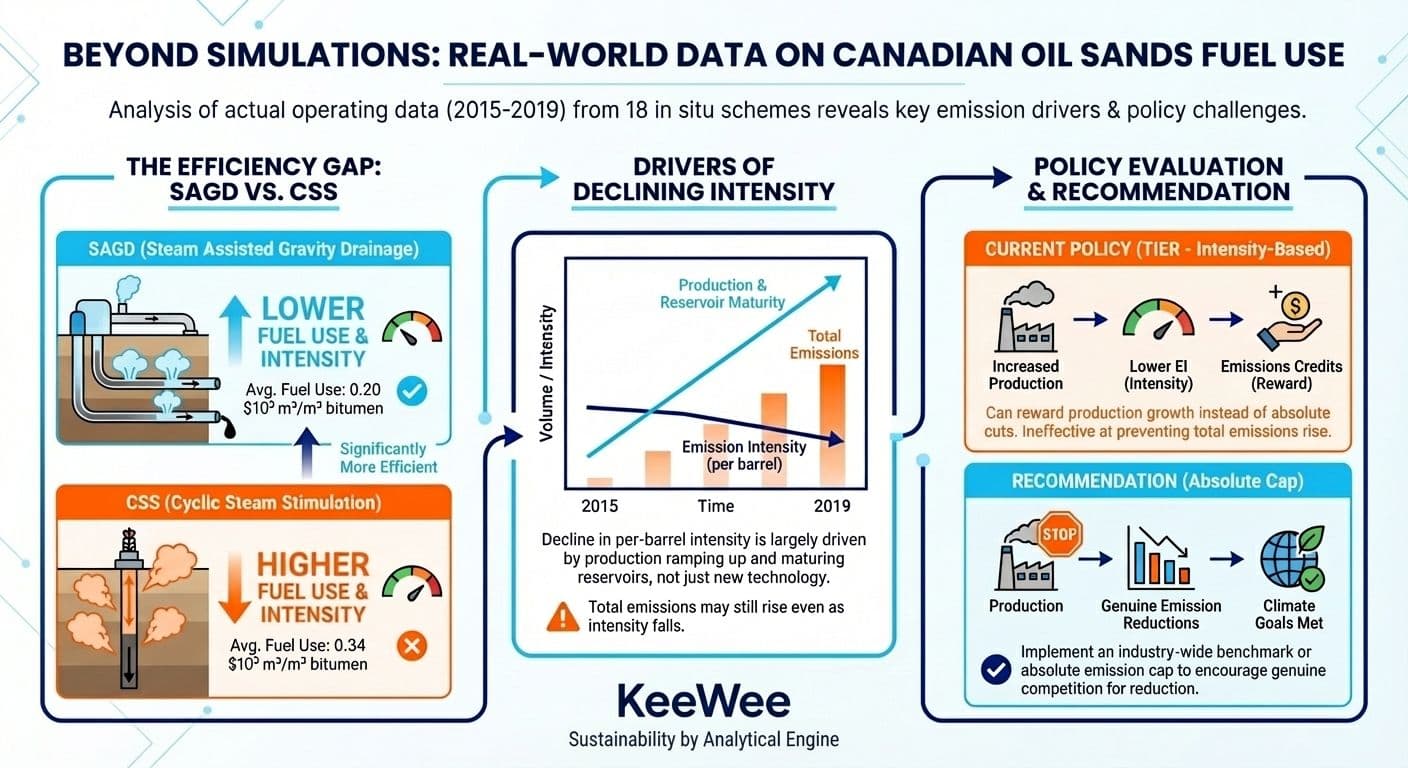
In situ extraction generally uses two main methods: Steam Assisted Gravity Drainage (SAGD) and Cyclic Steam Stimulation (CSS). Our analysis of real-world data confirmed a significant difference in fuel consumption between the two.
Between 2015 and 2019, schemes using SAGD consumed significantly less fuel per cubic meter of bitumen produced compared to those using CSS. Consequently, the average emission intensities (EIs) for SAGD operations were notably lower than their CSS counterparts.
The Drivers of Declining Intensity
While the industry has seen a decline in overall emissions intensity (emissions per barrel), the data suggests this isn't solely due to new technological breakthroughs.
Our study points out that production ramping up and the natural maturity of reservoirs have played significant roles in driving down EI values. Simply put, as facilities scale up production, they become more efficient per unit, even if their total emissions rise.
Evaluating Alberta’s TIER System
The study also evaluated the effectiveness of Alberta's Technology Innovation and Emissions Reduction (TIER) regulation.
Our findings suggest that intensity-based cap and trade systems can have unintended consequences. Because these systems focus on emissions per unit rather than total emissions, operations can sometimes be rewarded with emission credits simply for increasing production, rather than achieving actual absolute emission reductions.
To effectively prevent facilities from simply increasing production to drive down EI values, our research suggests that an industry-wide benchmark or an absolute emission cap should be considered to encourage genuine competition for emission reductions.
Read the Full Study
For a deep dive into the methodology, detailed data analysis, and policy recommendations, you can access the full paper here: "Fuel consumption analysis and cap and trade system evaluation for Canadian in situ oil sands extraction" (ScienceDirect)