
OpenPEMS®
Free, open-source predictive emissions monitoring software that uses machine learning to predict NOₓ, SO₂ and other air emissions, for use across Canada and internationally.
What is PEMS?
Predictive emissions monitoring software uses a model, existing facility sensors and historical operating data to predict air emissions such as NOₓ and SO₂, as an alternative to continuous emissions monitoring systems (CEMS).
Once trained on four months of CEMS data, OpenPEMS® can predict emissions continuously, including for sources with no CEMS unit.
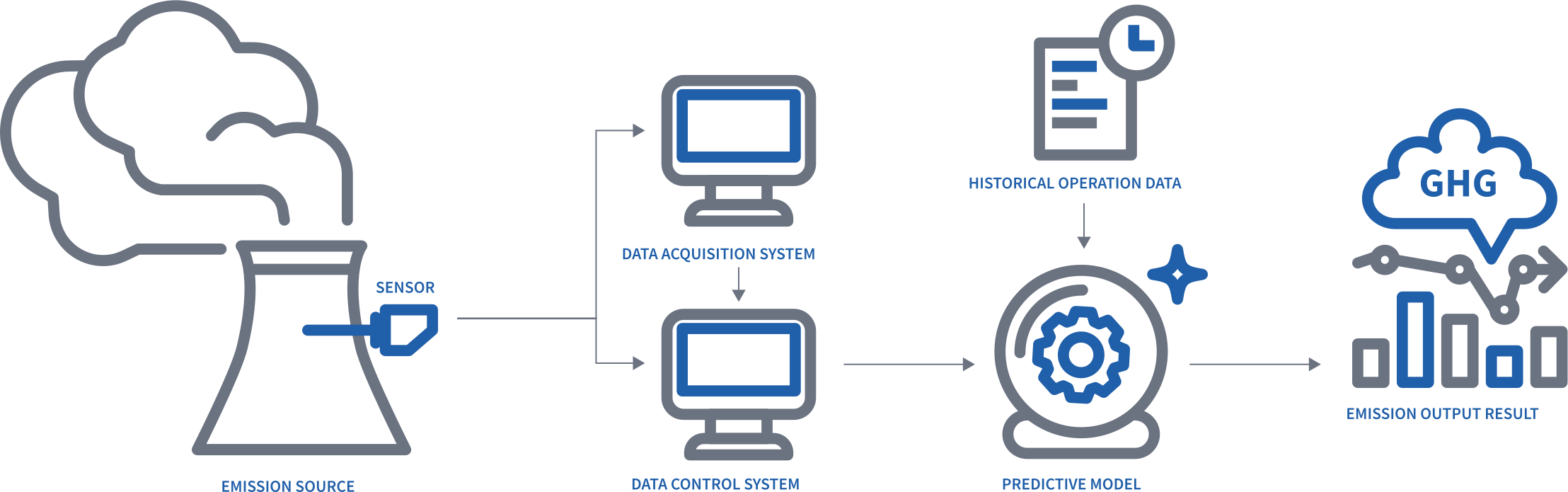
Swipe to see the full diagram
Why predictive monitoring
Cost-effective
No costly maintenance of specialised hardware.
Software-based
Uses data from existing facility sensors and a predictive model.
Regulatory approved
First PEMS approved by Alberta Environment and the AER, and an accepted alternative to CEMS federally and provincially.
Quick set-up
Can be installed in less than six weeks.
No extra calibration
Relies on facility sensors already maintained on standard schedules.
50+ years in use
Used in the US since the 1970s and approved by the US EPA under Performance Specification 16.
Emissions it can predict
- NOₓNitrogen oxides
- SO₂Sulfur dioxide
- CH₄Methane
- PMParticulate matter
- CO₂Carbon dioxide
- H₂SHydrogen sulfide
Why switch to OpenPEMS®
Reliable, continuous data for every emission source, even the ones without a CEMS.
Continuous monitoring
Emissions from every source can be monitored all the time.
Large and small sources
Works for sources of any size across the supply chain.
Primary or backup
Run it as the primary method, or as a CEMS backup when the analyser is out of service.
No specialised equipment
Software only, so no special sensors or probes are needed long-term.
Further reading
- PublicationPEMS development with a neural networkDevelopment of a predictive emissions monitoring system using Keras, an open-source machine learning library.Read more (opens in a new tab)
- PublicationPEMS development with gradient boostingDevelopment of a predictive emissions model using a gradient boosting machine learning method.Read more (opens in a new tab)
- PublicationLong-term evaluation of ML-based air emission monitoringA long-term study of model accuracy, overfitting and regulatory challenges.Read more (opens in a new tab)
Swipe to see all 3
Contact us
Questions about verification, reporting, data science or training? Send us a message and we’ll get back to you as soon as we can.
- Emailinfo@keewee.ca
- Phone(213) 720-3663
- OfficeCalgary, Alberta, Canada