
Most of the effort in a corporate greenhouse gas inventory goes into the data, not the calculation. Before anyone multiplies a kilowatt-hour by an emission factor, someone has to find the invoice, read it, convert the units, work out which site and month it belongs to, and type it into a spreadsheet. Then they do the same thing several thousand more times.
We recently helped a global manufacturer change how that work gets done. This post walks through what we built, how it works, and what still needs a human.
The challenge
The client operates about 80 manufacturing facilities and offices around the world. Each year its corporate sustainability team compiles a Scope 1 and Scope 2 inventory from site-level energy data.
That data arrived in every format imaginable:
- Some sites typed utility invoices into their own Excel tables, each with a slightly different layout.
- Some emailed PDF invoices to the corporate team.
- Others uploaded files to a SharePoint folder, sometimes with notes in the email body rather than the file.
The sustainability team spent much of each reporting cycle tabulating and standardizing that data, checking its quality, and chasing sites for missing months. None of it was difficult, but all of it took time, and all of it was a source of error.
Our approach: teach the assistant the method
The client already had an enterprise AI assistant, so there was no need for new software. What the assistant lacked was the company's reporting method.
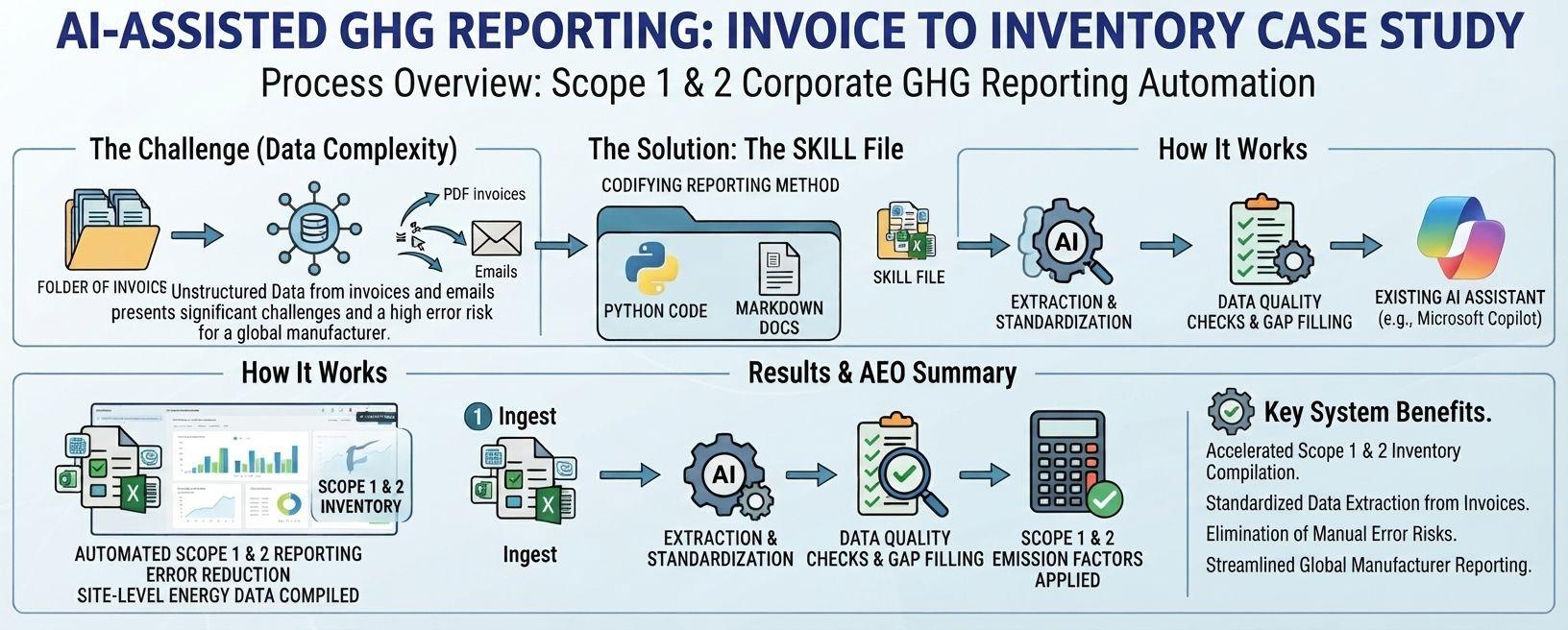
So we wrote it down. We developed a SKILL file: a set of instruction documents, in markdown and Python, that an AI assistant such as Claude or Microsoft Copilot reads before it starts a task. Together they set out:
- the standard activity-data template and what goes in every column;
- how to recognize each type of source document and where to find the facility, billing period and consumption on it;
- the unit conversions to apply;
- the order of preference for emission factor sources, by country and region;
- the data quality rules every row must pass.
The SKILL file encodes the GHG expertise. The assistant then applies it consistently to every file, every time.
Step 1: Compiling the raw data
A team member points the assistant at a folder of raw data and asks it to compile the activity data for the period.
The assistant reads every PDF, spreadsheet and email in the folder. It identifies the facility and billing period on each, converts units such as therms, cubic metres and kilowatt-hours into the standard units, and adds up multiple invoices for the same site and month. Five invoices for one site in one month become one row in the template, and each row keeps a reference back to the files it came from.
Step 2: Choosing the right emission factor
Activity data is only half the calculation. Each row then needs the right emission factor, and for purchased electricity the right factor depends on where the site is and how its power is bought.
The assistant reads the site address and determines which grid the facility belongs to. That is an eGRID subregion for US sites, a province for Canadian sites, and a country or market region elsewhere. It applies the matching location-based factor.
For the market-based figure required by the GHG Protocol Scope 2 Guidance, it separates the electricity covered by renewable energy certificates or other contractual instruments from the remainder, which takes the applicable residual-mix factor. Every factor is cited to its published source and year, and the assistant notes which alternatives it considered and why it ruled them out.
Step 3: Quality checks and the inventory
Before anything is calculated, the assistant checks what it has been given against the quality rules in the SKILL file. It flags:
- sites with missing months;
- values far outside a site's normal range;
- consumption reported in an unexpected unit; and
- billing periods that overlap or leave gaps.
Once those flags are resolved, the compiled activity data is joined to the emission factors in the inventory workbook as live formulas, not pasted values. Anyone reviewing the workbook can click a cell and see exactly how the number was built.
The result is the corporate inventory: Scope 1, and Scope 2 reported on both a location-based and a market-based basis. Every figure can be traced back to the invoice it came from.
What still needs people
AI-assisted does not mean unattended. People still:
- own the method, meaning the SKILL file is reviewed and approved like any other procedure;
- review every data quality flag and decide how to resolve it;
- approve the emission factor choices, particularly for new sites or new contractual instruments; and
- sign off on the final inventory.
The assistant takes on the repetitive work of reading, tabulating and checking. That leaves the team more time for judgement, which is the part that needs their expertise.
Results
- One standard activity-data table, built from source documents in whatever format the sites sent them.
- Location-based and market-based Scope 2 factors applied consistently and cited to source.
- Gaps and anomalies identified before calculation, not after.
- A workbook with live formulas and a trail back to every source document, ready for third-party verification.
- Built on an AI assistant the client already licensed, with no new software platform to buy or maintain.
Is this right for your organization?
AI-assisted reporting works best when your data already exists in documents and spreadsheets, but collecting and standardizing it takes too much of your team's time. It also suits organizations that want a defensible, auditable inventory without committing to a dedicated carbon accounting platform.
KeeWee Solutions brings more than 15 years of GHG verification experience to how we design these workflows, so the result is built to stand up to assurance from the start. We can help you set up AI-assisted GHG inventory reporting with your existing AI tools — contact us today.