
Comprehensive Guide to Assurance and Verification Conclusions: Unmodified, Emphasis of Matter, Modified, Adverse, and Disclaimer
By Minxing Si · GHGVerification
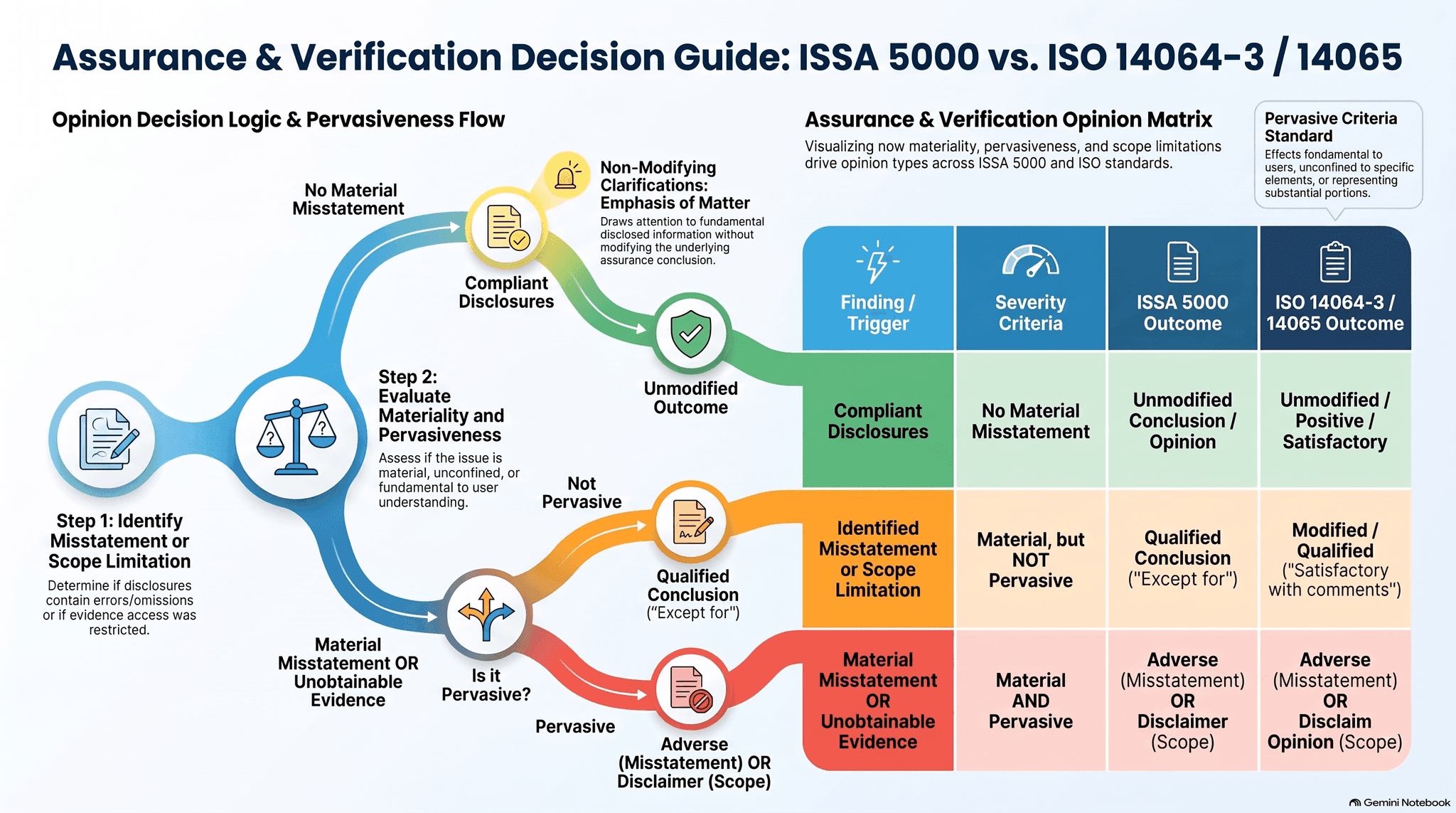
This reference guide details the criteria, triggers, and reporting structures for the five primary types of assurance outcomes under international sustainability and environmental verification standards:
- IAASB ISSA 5000 (General Requirements for Sustainability Assurance Engagements)
- ISO 14064-3:2019 (Greenhouse Gases — Part 3: Specification with guidance for the verification and validation of greenhouse gas statements)
- ISO 14065:2020 (General principles and requirements for bodies validating and verifying environmental information)
- ISO/IEC 17029:2019 (Conformity assessment — General principles and requirements for validation and verification bodies)
1. Core Foundational Concepts
A. Misstatement vs. Scope Limitation
- Misstatement: A difference between the reported disclosures and the appropriate measurement or evaluation of the subject matter in accordance with the applicable criteria. Misstatements can arise from error or fraud, may be quantitative or qualitative, and include omitted or obscured information (ISSA 5000 Para. 18; ISO 14065 Clause 3.3.21).
- Scope Limitation: An inability to obtain sufficient appropriate evidence to form a conclusion. Scope limitations arise from circumstances beyond the entity's control, nature/timing of the work, or restrictions imposed by management (ISSA 5000 Para. 185, A530).
B. Materiality vs. Pervasiveness
- Materiality: Information is material if misstatements, individually or in the aggregate, could reasonably be expected to influence decisions of intended users taken on the basis of the sustainability or GHG statement (ISSA 5000 Para. 18; ISO 14064-3 Clause 3.6.9).
- Pervasiveness: Pervasive effects on disclosures are those that, in the practitioner's/verifier's professional judgment:
- Are not confined to specific elements, classifications, or line items;
- If confined, represent or could represent a substantial proportion of the disclosures; or
- Are fundamental to the intended users' understanding of the information (ISSA 5000 Para. A591; ISO 14065 Table A.2).
2. Detailed Breakdown of Opinion / Conclusion Types
1. Unmodified Conclusion / Opinion ("Clean")
- Definition: Issued when the practitioner/verifier concludes that the statement is prepared, in all material respects, in accordance with the applicable criteria and supported by sufficient appropriate evidence.
- Level of Assurance Formats:
- Reasonable Assurance (Positive Form): "In our opinion, the entity's GHG/sustainability statement is fairly presented, in all material respects, in accordance with XYZ criteria." (ISSA 5000 Para. 198R, A546R; ISO 14064-3 Clause 6.3.2).
- Limited Assurance (Negative Form): "Based on the procedures performed and evidence obtained, nothing has come to our attention that causes us to believe that the GHG/sustainability statement is not fairly presented, in all material respects, in accordance with XYZ criteria." (ISSA 5000 Para. 198L, A545L).
- Standard References: ISSA 5000 Paragraphs 198L/198R; ISO 14064-3 Clause 6.3.2; ISO 14065 Clause 9.7.1.6 & Table A.1.
2. Emphasis of Matter Paragraph
- Definition: A separate section included in the assurance/verification report to draw intended users' attention to a matter properly presented or disclosed in the sustainability/GHG statement that is of such importance that it is fundamental to users' understanding (ISSA 5000 Para. 199(a), A580).
- Crucial Rule: An Emphasis of Matter paragraph does NOT modify the practitioner's conclusion. It explicitly states that the conclusion/opinion is not modified in respect of the matter emphasized (ISSA 5000 Para. 189, 199). It is never a substitute for a modified conclusion or forcing management to correct an error.
- Key Triggers:
- Criteria Designed for Specific Purpose: Alerting users that criteria are tailored for specific regulatory or user needs and may be unsuitable for other purposes (ISSA 5000 Para. 200).
- Changes in Criteria or Methods: Significant changes, updates, or reinterpretations of quantification methodologies or baselines that have a fundamental effect (ISSA 5000 Para. A580(a)).
- Significant Operational Events: Major events or system breakdowns during the period affecting operational controls, provided they are properly disclosed (ISSA 5000 Para. A580(b)).
- Management-Disclosed Misstatements: Under specific engagement terms where management explicitly identifies and properly describes a material misstatement within their statement (ISSA 5000 Para. 206(b)).
- Standard References: ISSA 5000 Paragraphs 189(a), 199, 200, 206(b), A579–A584; ISO 14064-3 Table 1.
3. Modified Conclusion / Opinion ("Qualified")
- Definition: Issued when there is a material misstatement OR a material scope limitation (e.g., unsupported data), but the effects or possible effects are material, but NOT pervasive across the report (ISSA 5000 Para. 203, 204; ISO 14065 Table A.2).
- Key Triggers:
- Uncorrected Material Misstatement: The practitioner finds an error or omission in specific line items that exceeds materiality, but the rest of the report remains reliable.
- Material Scope Limitation (Unsupported Data): Missing records or unverified data points that could materially impact specific disclosures, but do not undermine the entire statement.
- Required Wording Structure: Phrased using "except for" language:
- Reasonable Assurance: "Except for the effect of the matter described in the Basis for Qualified Conclusion section of our report, the statement is prepared, in all material respects, in accordance with XYZ criteria." (ISSA 5000 Para. A594R).
- Limited Assurance: "Based on our procedures, except for the possible effect of the matter described in the Basis for Qualified Conclusion section, nothing has come to our attention..." (ISSA 5000 Para. A593L).
- Standard References: ISSA 5000 Paragraphs 203, 204, A587–A594R; ISO 14065 Clause 9.7.1.6 & Table A.2.
4. Adverse Conclusion / Opinion
- Definition: Issued when the practitioner/verifier determines that uncorrected misstatements are both material AND pervasive to the sustainability or GHG statement (ISSA 5000 Para. 203(b), 204; ISO 14065 Clause 9.7.1.6 & Table A.2).
- Key Triggers:
- Widespread material misstatements across multiple disclosures or core metrics.
- Misleading presentation, aggressive management bias, or intentional manipulation that renders the overall report non-compliant and untrustworthy.
- Required Wording Structure:
- "Because of the significance of the matter described in the Basis for Adverse Conclusion section of our report, the accompanying statement does not present fairly [or is not prepared in accordance with] XYZ criteria." (ISSA 5000 Para. A595; ISO 14064-3 Clause 6.3.2).
- Standard References: ISSA 5000 Paragraphs 203(b), 204, A595; ISO 14064-3 Clause 6.3.2; ISO 14065 Clause 9.7.1.6 & Table A.2.
5. Disclaimer of Conclusion / Opinion
- Definition: Issued when the practitioner/verifier is unable to obtain sufficient appropriate evidence due to a scope limitation, and the possible effects of undetected misstatements could be both material AND pervasive (ISSA 5000 Para. 170, 185, 203(a); ISO 14065 Clause 9.7.1.7).
- Key Triggers:
- Severe lack of records, destroyed documentation, or refusal of management/value chain entities to provide critical evidence covering fundamental parts of the report.
- Fundamental doubt about the integrity of management or written representations (ISSA 5000 Para. 170).
- Required Wording Structure:
- "Because of the significance of the matter described in the Basis for Disclaimer of Conclusion section of our report, we have not been able to obtain sufficient appropriate evidence to form a conclusion... Accordingly, we do not express a conclusion on the statement." (ISSA 5000 Para. A595; ISO 14064-3 Clause 6.3.2).
- Standard References: ISSA 5000 Paragraphs 170, 185, 203(a), A595; ISO 14064-3 Clause 6.3.2; ISO 14065 Clause 9.7.1.7 & Table A.2.
3. Comprehensive Summary Decision Matrix
| Opinion / Report Type | Underlying Scenario | Materiality & Pervasiveness | Impact on Assurance Conclusion | Key Wording & Placement |
|---|---|---|---|---|
| Unmodified (Clean) | Disclosures conform to criteria and are fully supported by sufficient evidence. | Immaterial or None | Unmodified. Full positive or negative assurance expressed. | "In our opinion..." (Reasonable) or "Nothing has come to our attention..." (Limited). |
| Emphasis of Matter | A fundamental matter is properly presented and disclosed in the report (e.g., criteria change, specific-purpose framework, major operational event). | Material / Fundamental, but NO uncorrected error or missing data exists. | Conclusion remains Unmodified. Does not modify or qualify the opinion. | Separate section titled "Emphasis of Matter" referencing specific note: "Our opinion is not modified in respect of this matter." |
| Modified (Qualified) | Uncorrected material misstatement OR scope limitation (missing/unsupported data). | Material, but NOT Pervasive (confined to specific disclosures or line items). | Modified. Issued with an "except for" qualification. | Basis for Qualified Conclusion section added: "Except for the [possible] effects of the matter described... " |
| Adverse | Uncorrected material misstatements, non-compliance, or misleading disclosures. | Material AND Pervasive (widespread across the report or core metrics). | Modified (Adverse). Concludes report is incorrect or misleading. | Basis for Adverse Conclusion section added: "Because of the significance of the matter... the statement is not prepared in accordance with criteria." |
| Disclaimer | Scope limitation / inability to obtain sufficient appropriate evidence for unsupported data. | Material AND Pervasive (missing evidence affects core or substantial portions). | No Conclusion Expressed. Declares inability to form an opinion. | Basis for Disclaimer section added: "Because of the significance of the matter... we do not express a conclusion." |
4. Practical Practitioner Guidance & Decision Tree
                                 [Evaluate Findings]
                                          |
            +-----------------------------+-----------------------------+
            |                                                           |
   [Misstatement Identified]                                  [Scope Limitation / Unsupported Data]
            |                                                           |
   +--------+--------+                                         +--------+--------+
   |                 |                                         |                 |
[Material?]       [Immaterial]                              [Material?]       [Immaterial]
   |                 |                                         |                 |
 Yes                 No --> Unmodified Opinion                Yes                 No --> Unmodified Opinion
   |                                                           |
[Pervasive?]                                                [Pervasive?]
   |                                                           |
 +-+-----+                                                   +-+-----+
 |       |                                                   |       |
Yes      No                                                 Yes      No
 |       |                                                   |       |
 v       v                                                   v       v
Adverse  Modified (Qualified)                               Disclaimer Modified (Qualified)
Key Rules to Remember:
- Emphasis of Matter vs. Modification: If management's disclosure contains an error, is incomplete, or is misleading, you cannot use an Emphasis of Matter paragraph to clear it—you must modify your conclusion.
- Qualitative Misstatements: Qualitative narratives (e.g., aggressive claims, misleading graphs, or selective reporting of positive impacts) can constitute material misstatements just like numerical errors (ISSA 5000 Para. A491–A492).
- Drafting Basis Sections: Any report containing a Modified, Adverse, or Disclaimer of Opinion, or an Emphasis of Matter paragraph, must include a dedicated basis section directly following the conclusion section explaining the specific reasons (ISSA 5000 Para. 190(d)).
Need a GHG verification?KeeWee is accredited by the Standards Council of Canada as a GHG validation and verification body.Request a quote