
Precision Reporting: Mastering CORSIA Fuel Monitoring Methods for Large Airline Operators
A practical guide to ICAO’s five approved CORSIA fuel monitoring methods, helping large airline operators transition from simplified modeling to precise emissions reporting.

Minxing Si -
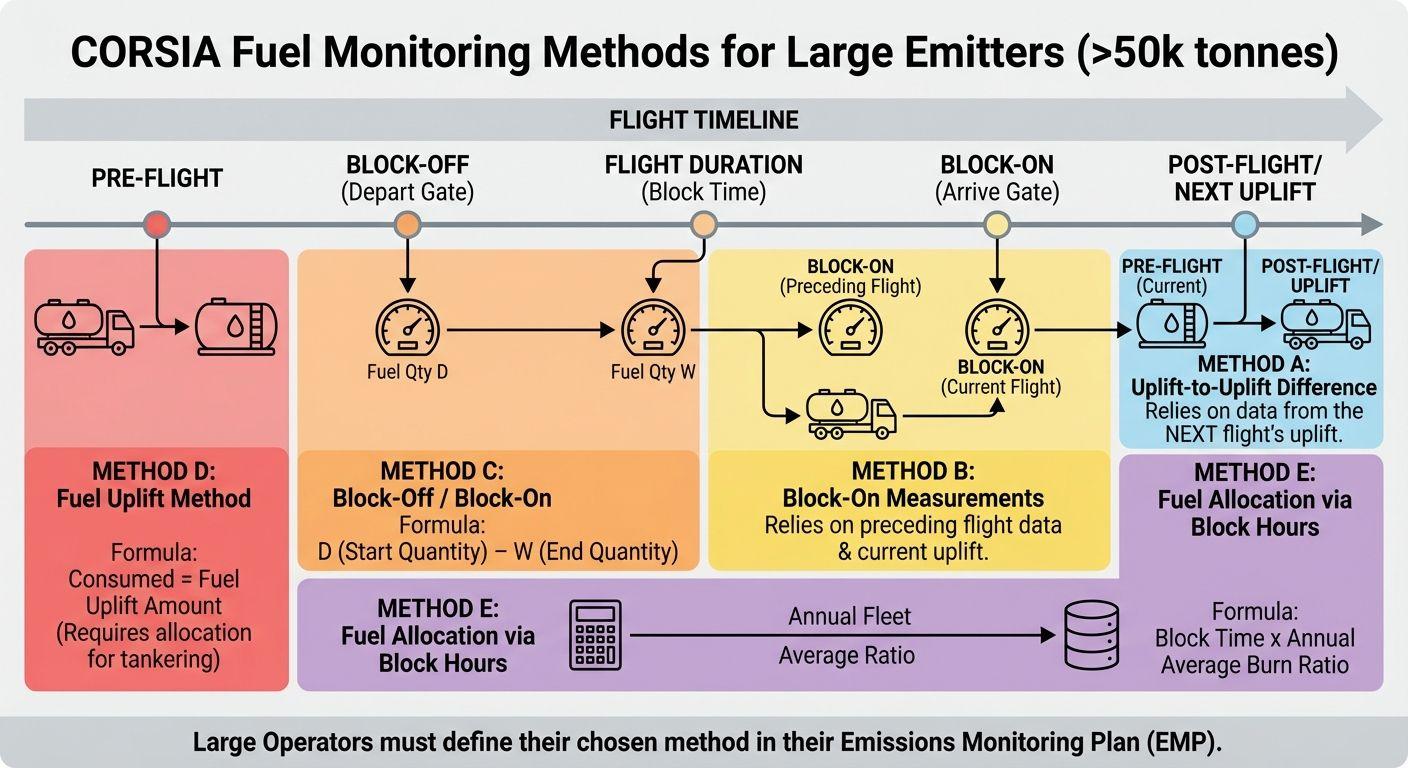
Under ICAO’s CORSIA scheme, once an airline operator exceeds the "small emitter" threshold—generating more than 50,000 tonnes of CO₂ annually from international flights subject to offsetting for two consecutive years—simplified modeling is no longer an option.
Large emitters must transition to monitoring actual fuel consumption for every international flight stage. This shift requires rigorous data collection and a clearly defined Emissions Monitoring Plan (EMP). ICAO approves five distinct monitoring methods, allowing airlines to choose the one that best fits their existing operational data flows.
The Crucial Definition: Block-Off and Block-On
Before exploring the five methods, it is vital to understand the standard definitions of flight timing used in CORSIA monitoring:
• Block-off: The precise moment the aircraft moves under its own power from the departure gate. Typically defined as the time between the last door closing and the first engine starting. • Block-on: The moment the aircraft comes to a rest at the arrival gate. Typically defined as the time between the last engine stopping and the first door opening.
The duration between these two points is Block Time, a core input for several monitoring methods.
The 5 Approved Fuel Monitoring Methods
Airlines must select one of the following methods and apply it consistently.
1. Method A: Uplift-to-Uplift Difference
This method calculates fuel consumed based on tank measurements taken before and after refueling events across consecutive flights.
• Formula: Fuel Consumed = (Fuel in tanks after current uplift) – (Fuel in tanks after next flight's uplift) + (Next uplift amount)
Operational Note: Because this method relies on data from the subsequent flight to calculate the current flight's consumption, operators are encouraged to collect measurements for all flights (including domestic legs) to prevent data gaps in the reporting chain.
2. Method B: Block-On Measurements
Similar to Method A, this approach relies on measurements from consecutive flights, but focuses on the fuel remaining at the moment of arrival (block-on).
• Formula: Fuel Consumed = (Fuel at block-on of preceding flight) – (Fuel at block-on of current flight) + (Current uplift amount)
3. Method C: Block-Off / Block-On Method
This is often considered the most intuitive method. It measures the simple difference in fuel quantity between the start of the journey (just before taxiing) and the end of the journey (parking at destination).
• Formula: Fuel Consumed = (Fuel in tanks at Block-off) – (Fuel in tanks at Block-on)
Requirement: Operators using this method must very clearly define the exact timing windows for their block-off and block-on measurements in their EMP.
4. Method D: Fuel Uplift Method
This approach bases monitoring strictly on the amount of fuel added to the aircraft before the flight.
• Formula: Fuel Consumed = Fuel uplift amount
Operational Note: If a flight does not have an uplift (e.g., due to "fuel tankering," where extra fuel is carried to avoid refueling at the destination), the operator must allocate consumption proportionally based on the block hours of all flights covered by the previous single uplift.
5. Method E: Fuel Allocation Using Block Hours
Instead of measuring every flight individually, this method uses a calculated average ratio.
• Step 1: At the end of the year, calculate an Average Fuel Burn Ratio for each aircraft type in your fleet (Total Yearly Uplifts ÷ Total Yearly Block Hours). • Step 2: Calculate individual flight consumption by applying that ratio to the flight’s duration (Fuel Consumed = Flight Block Time × Average Fuel Burn Ratio).
To ensure accuracy for CORSIA, ICAO recommends calculating the initial ratio using data from international flights only, whenever feasible.
Conclusion
Transitioning to actual fuel monitoring requires precise definitions and robust data management systems. Whether relying on direct tank measurements at block times or using uplift-based allocations, large operators must ensure their chosen method is documented in their Emissions Monitoring Plan and applied consistently to meet international reporting standards.