
Demystifying CORSIA: A Guide to Simplified CO₂ Monitoring for Small Airline Operators
A practical guide to CORSIA’s simplified monitoring pathway, explaining who can use the ICAO CERT tool and how emissions are calculated for small emitters, new entrants, and exempt flights.

Minxing Si -
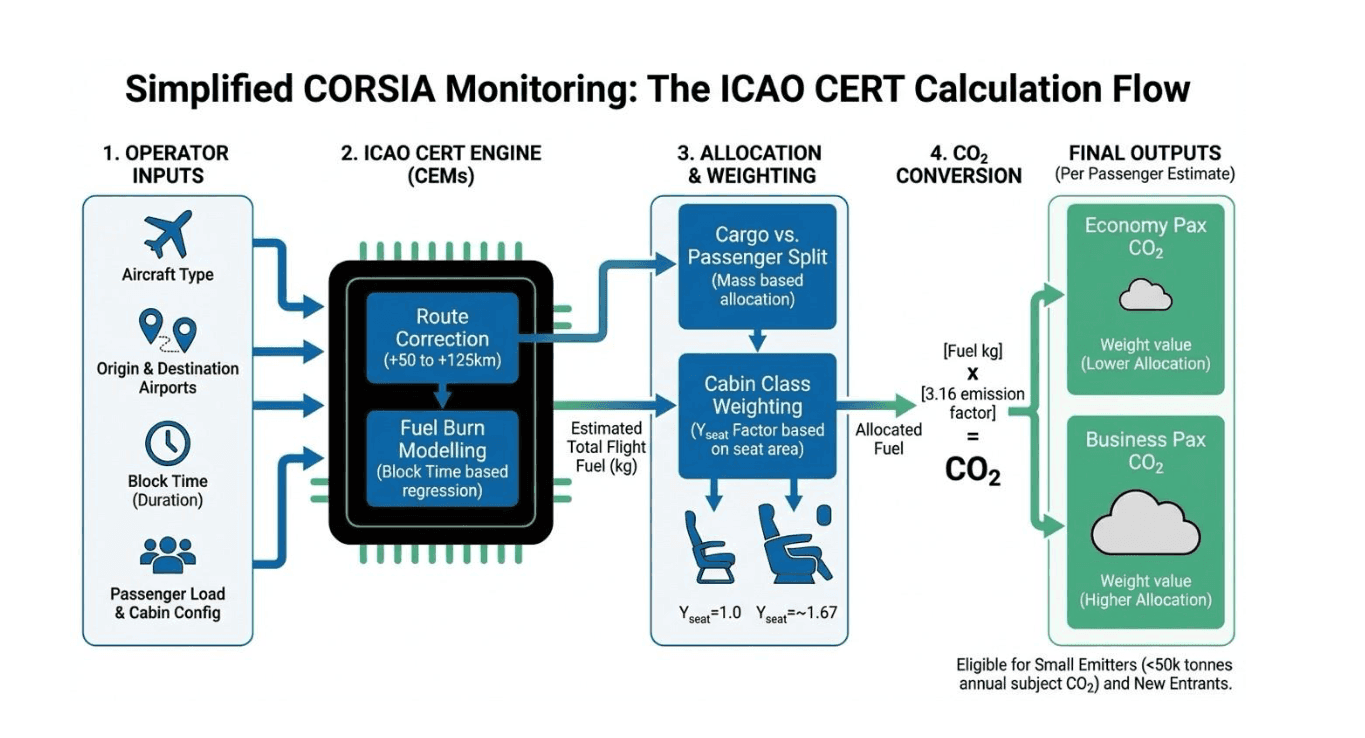
For airline operators, complying with the Carbon Offsetting and Reduction Scheme for International Aviation (CORSIA) is mandatory, but the method of compliance depends heavily on your size. ICAO defines two primary categories for monitoring and reporting CO₂ emissions:
- Fuel Use Monitoring Methods (requiring actual fuel measurements) for larger operators.
- Simplified Monitoring using the ICAO CORSIA CERT tool for smaller operators.
This guide focuses on the second path: the simplified route designed to reduce the administrative burden on smaller aviation businesses.
Who is Eligible for Simplified Monitoring (CERT)?
The ICAO CORSIA CO₂ Estimation and Reporting Tool (CERT) is a software tool that allows operators to estimate emissions using models rather than monitoring actual physical fuel uplift for every flight.
You are eligible to use this simplified approach if you fall into one of these categories: • Small Emitters: Your total annual CO₂ emissions from international flights subject to offsetting requirements are less than 50,000 tonnes. • New Entrants: You fall under the scope of CORSIA for the first time (after Jan 1, 2021). You may use CERT for your first compliance year. • Exempt Flights: You are reporting on international flights that are not subject to offsetting requirements, regardless of your airline's size.
Note: If an operator using CERT exceeds the 50,000-tonne threshold for two consecutive years, they must transition to a full Fuel Use Monitoring Method.
How the ICAO CERT Tool Works
Instead of measuring fuel in tanks, CERT uses "CO₂ Estimation Models" (CEMs). When you input your flight data, the model maps your specific aircraft type to an equivalent fuel-burn profile based on standardized ICAO data.
A critical input for CERT is Block Time. While simple models might just use Great Circle Distance (GCD), block time is far more accurate for estimating fuel burn because it reflects operational realities: • Prevailing winds: Headwinds or tailwinds that significantly alter fuel burn. • Air traffic stacking: Time spent circling in holding patterns. • Indirect routings: Necessary deviations from the shortest geographical path.
Block time measures the actual duration from the moment the aircraft moves from the departure gate (block-off) until it stops at the arrival gate (block-on).
The 5-Step Calculation Process Behind CERT
While the software does the heavy lifting, it is crucial for operators to understand how their emissions are calculated. Here is the step-by-step breakdown of the CERT methodology:
Step 1: Route Distance Corrections
CERT starts with the Great Circle Distance (GCD) between airports. It then adds a correction factor to account for real-world routing inefficiencies:
• Flights < 550 km: +50 km • Flights 550–5,500 km: +100 km • Flights > 5,500 km: +125 km
Step 2: Estimating Aircraft Fuel Consumption
The tool maps your aircraft to one of 336 equivalent types in its database. It estimates total fuel consumption in kilograms using ICAO formulas based on your input of corrected flight distance or block time.
Step 3: Passenger Allocation Factors
The total fuel is then adjusted to separate passenger emissions from cargo emissions. The model removes the share of fuel attributed to belly cargo based on mass. It assumes 100kg per passenger (body + baggage) plus 50kg for onboard infrastructure, adjusted by historical load factors for that route.
Step 4: Cabin Class Weighting (The "Yseat" Factor)
Not all seats have the same carbon footprint. Premium seats occupy more space and add more weight. CERT applies a "Yseat factor" based on seat width and pitch ratios to distribute emissions fairly. A business class seat will always be assigned a higher share of the flight's CO₂ than an economy seat.
Step 5: Final CO₂ Conversion
Finally, the allocated fuel mass is converted into CO₂ using fixed emission factors (e.g., 3.16 kg CO₂ per kg of Jet-A fuel).
A Worked Example: The "Premium" Effect
Illustrative calculation for a Boeing 787-9 flying Calgary (YYC) to Tokyo (NRT)
Let's see how these steps affect final reporting for a long-haul flight using illustrative data.
- Route: YYC to NRT is approx. 7,945 km GCD. CERT adds the +125 km correction factor for a total corrected distance of 8,070 km.
- Fuel Estimate: The model estimates total fuel burn for this distance at 62,000 kg.
- Total CO₂: 62,000 kg fuel × 3.16 factor = 195,920 kg CO₂ for the whole flight.
- Passenger Weighting: The aircraft has 224 Economy seats and 28 Business seats (85% load factor). o Because Business seats have a much larger surface area, CERT calculates their "Yseat factor" at roughly 1.67, whereas economy is 1.0.
- Final Allocation: When the total CO₂ is divided based on these weighted factors: o Economy passenger footprint: ~852 kg CO₂ o Business passenger footprint: ~1,422 kg CO₂
This demonstrates how the simplified monitoring tool still provides granular data, highlighting that premium travel carries a significantly higher carbon "cost" per passenger due to spatial inefficiency.