
Why "Glass Box" AI is the Future of Emissions Compliance: Beyond the Neural Network Hype
Peer-reviewed research shows how explainable, tree-based machine learning models like XGBoost can deliver regulatory-ready NOₓ predictions without black-box complexity.

KeeWee -
The Problem with “Black Box” Accuracy
Predictive Emissions Monitoring Systems (PEMS) have existed for decades, but recent advances in machine learning have renewed interest in their use as lower-cost alternatives to Continuous Emissions Monitoring Systems (CEMS).
Much of the recent PEMS research has focused on artificial neural networks (ANNs), which often deliver strong accuracy. However, ANNs are frequently criticized as black boxes—difficult for operators, regulators, and decision-makers to interpret or trust.
A peer-reviewed study led by Minxing Si (now founder of KeeWee Solutions) published in Environmental Technology & Innovation explored a different approach: tree-based gradient boosting, specifically using the open-source XGBoost algorithm. The results suggest that model interpretability and regulatory practicality matter just as much as raw accuracy.
What the Study Examined
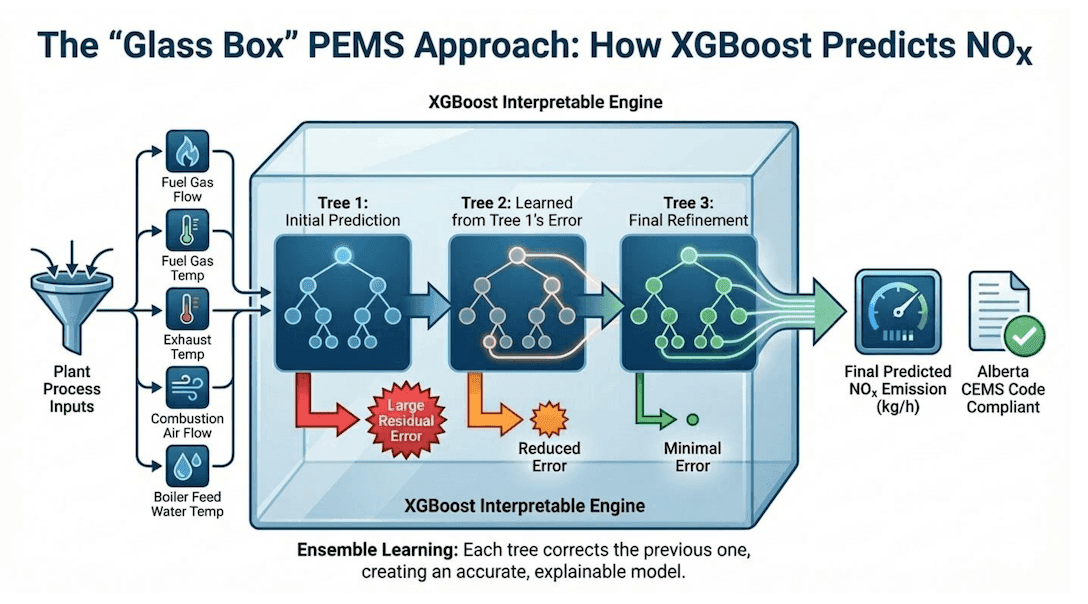
The study developed a predictive model for NOₓ emissions from an industrial boiler using XGBoost, a tree-based ensemble learning method. Instead of a complex neural web, think of it as many readable decision trees working together. Five common process parameters were used as inputs, with NOₓ mass emissions as the output.
The model was trained on over 200,000 high-resolution samples and tested against more than 50,000 independent samples, then evaluated using the US EPA Performance Specification 16 (PS16) requirements for PEMS precision.
For comparison, an ANN model was trained and tested using the same datasets.
Key Result: High Accuracy Without the Black Box
The XGBoost model:
- Regulatory Ready: Passed all EPA PS16 and Alberta CEMS Code statistical tests for precision.
- High Precision: Achieved a Pearson correlation of 0.98 with measured CEMS emissions.
- Lower Error: Delivered substantially lower error (RMSE) than the ANN comparison model.
More importantly, the tree-based structure allowed users to identify which input parameters mattered most and how predictions were formed—something that is far more difficult with neural networks.
For industry, this matters because regulatory acceptance often hinges on explainability, not just performance.
Model Robustness and Sensor Failure
Regulatory frameworks require PEMS to remain functional when one or more input sensors fail. The study tested model sensitivity under simulated sensor outages using simple data substitution methods.
Even under single- and two-sensor failure scenarios, the XGBoost model remained within regulatory accuracy limits. This demonstrated that complex, expensive data imputation software is not always required to maintain compliance—an important consideration for practical deployment.
Performance Under Non-Normal Conditions
Like most predictive models, performance declined under non-normal operating conditions (N-NOCs) such as startups, shutdowns, and process upsets. However, XGBoost consistently outperformed the ANN model during these transient events.
That said, the study honestly highlights that predicting extreme emission peaks remains a challenge for any modeling approach, reinforcing that PEMS should be implemented with appropriate operational safeguards.
Industry Takeaway
This research proves that machine learning for emissions monitoring does not have to be opaque to be accurate.
Tree-based models like XGBoost provide a compelling middle ground—combining state-of-the-art predictive performance with the interpretability and robustness required for regulatory alignment.
For industry, the lesson is clear: the most complex algorithm is not always the best fit. In regulated environments, trust, transparency, and auditability are often the deciding factors.
About KeeWee Solutions Inc.
While the study proves that open-source PEMS is feasible, navigating the intersection of data science and regulatory approval can be challenging.
KeeWee Solutions Inc. was founded on the principles highlighted in this research. We believe that compliance shouldn't be cost-prohibitive.
We offer free PEMS model development to help facilities determine if a software-based solution is viable for their specific equipment before they commit to significant expenditures.
Furthermore, a great model is only useful if it is accepted by regulators. Minxing Si, lead researcher on this study and the founder of KeeWee, brings extensive experience in PEMS regulatory applications and successful approvals with Alberta Environment and Protected Areas (AEPA) and the Alberta Energy Regulator (AER). We bridge the gap between advanced AI modeling and meeting real-world regulatory requirements.