
Can Open-Source Deep Learning Models Replace Expensive Stack Analyzers? This Study Says Yes.
A study led by Minxing Si of KeeWee Solutions Inc. demonstrates how facility operators can achieve stringent regulatory precision requirements for NOx monitoring using standard process data and free machine learning libraries.

KeeWee -
The High Cost of Compliance
For industrial facilities operating turbines, boilers, and cogeneration units, monitoring air emissions isn't just an environmental responsibility—it's a strict regulatory mandate. Traditionally, this has meant installing Continuous Emissions Monitoring Systems (CEMS).
While effective, CEMS are expensive hardware solutions. They require significant upfront capital, specialized on-site training, and ongoing, costly maintenance. Furthermore, they are prone to downtime, leading to data gaps.
What if you could accurately calculate emissions using the data you already collect, without the expensive analyzer in the stack?
Enter PEMS: The Software Alternative
A Predictive Emissions Monitoring System (PEMS) does exactly that. Instead of physically measuring pollutants in the exhaust gas, PEMS uses machine learning (ML) and historical data to determine emissions based on process parameters like fuel flow, temperature, and pressure.
PEMS offers estimated capital cost savings of 50% compared to CEMS, along with significantly lower maintenance burdens.
While commercial PEMS solutions exist, they can often be expensive “proprietary black boxes" with high licensing fees and reliance on vendor support for adjustments. Minxing Si of KeeWee Solutions Inc. challenges this model.
DIY PEMS with Open-Source Machine Learning Libraries
The study, titled "Development of Predictive Emissions Monitoring System Using Open Source Machine Learning Library – Keras," set out to prove a crucial point: Facility operators can build their own highly accurate PEMS using free, open-source tools.
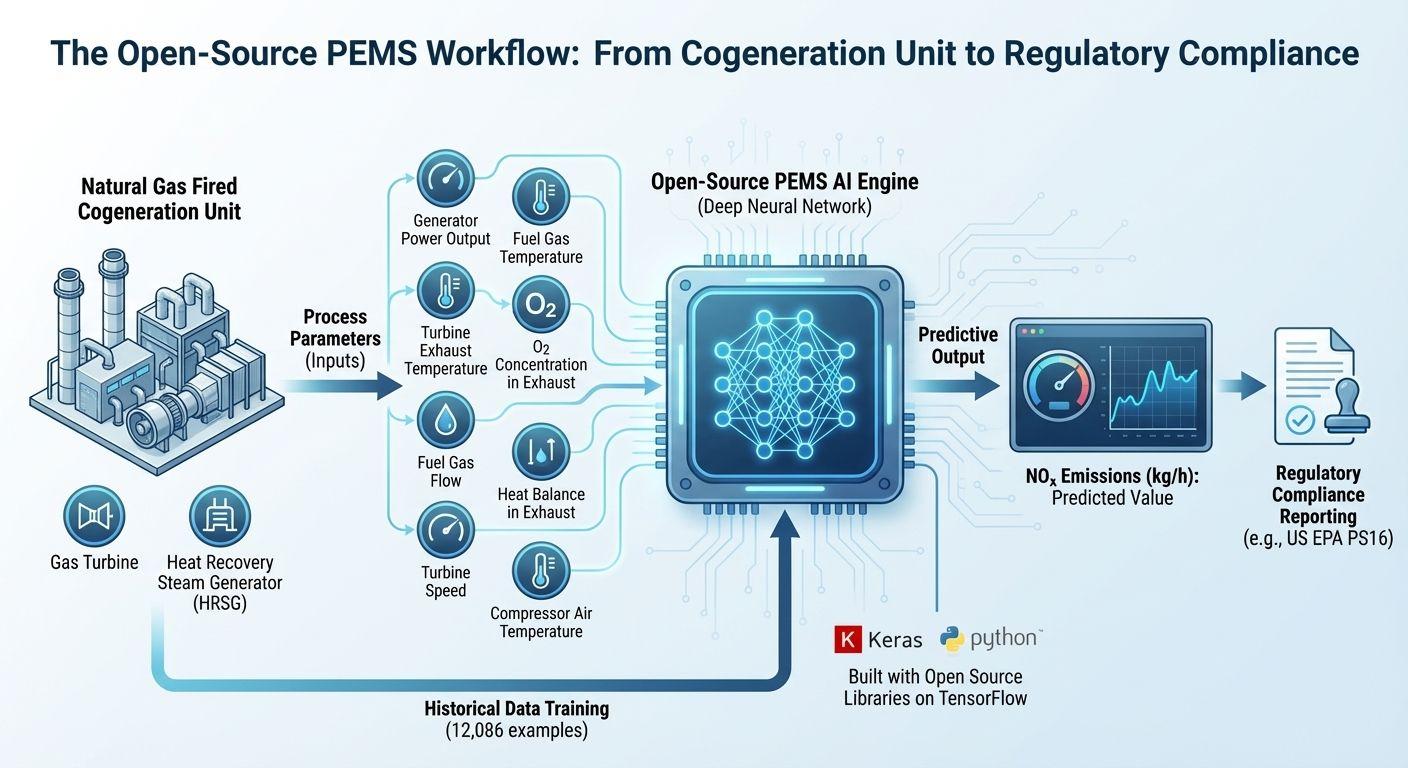
The research team developed a PEMS to predict NOx emissions from a natural gas-fired cogeneration unit in Alberta, Canada. Instead of proprietary software, they used:
- Python and R: Standard, open-source programming languages.
- Keras: A powerful, high-level neural network library running on top of TensorFlow.
The Methodology
The team utilized historical data where physical CEMS measurements and process parameters were collected simultaneously.
- Data Input: They selected 8 key process parameters already being measured at the facility (including generator power, fuel gas temperature, turbine exhaust temperature, and air flow).
- The ML Model: They trained Deep Neural Networks using 12,086 examples of operational data. They tested various network structures (different numbers of layers and "neurons") and optimization methods.
- The Goal: The model had to predict NOx emissions accurately enough to meet the stringent requirements of the US EPA Performance Specification 16 (PS16).
The Results: Regulatory Precision Achieved
The results were definitive. All nine variations of the neural network models developed by the team met the regulatory requirements for precision.
Its performance against the test dataset was exceptional:
- High Correlation: An r-value of 0.9451 between predicted and measured values.
- Low Error: A remarkably small difference of just 0.14% between the total measured and predicted emission values over the test period.
Why This Matters for Industry
This case study is a significant milestone for industrial environmental monitoring for several reasons:
- Cost Reduction: It confirms the feasibility of moving away from expensive CEMS hardware towards lower-cost software solutions.
- Accessibility: By successfully using open-source libraries, the study shows that you don’t need proprietary, expensive software to build compliant models. The tools are available to any data science team.
- Ownership & Flexibility: Building a PEMS in-house means the facility owns the model. Adjustments for equipment changes don't require expensive vendor service calls.
- Data Utilization: It makes better use of the vast amounts of process data facilities already collect.
The transition to AI-driven environmental monitoring is no longer a futuristic concept; it is a proven, compliant reality. By leveraging open-source deep learning libraries like Keras/TensorFlow, industrial facilities can take control of their emissions monitoring, reduce overhead costs, and maintain rigorous environmental standards.
To read the full methodology and statistical analysis, access the original IEEE Access paper here
About KeeWee Solutions Inc.
While the study proves that open-source PEMS is feasible, navigating the intersection of data science and regulatory approval can be challenging.
KeeWee Solutions Inc. was founded on the principles highlighted in this research. We believe that compliance shouldn't be cost-prohibitive.
We offer free PEMS model development to help facilities determine if a software-based solution is viable for their specific equipment before they commit to significant expenditures.
Furthermore, a great model is only useful if it is accepted by regulators. Minxing Si, lead researcher on the IEEE Access study and the founder of KeeWee, brings extensive experience in PEMS regulatory applications and successful approvals with Alberta Environment and Protected Areas (AEPA) and the Alberta Energy Regulator (AER). We bridge the gap between advanced AI modeling and meeting real-world regulatory requirements.